Luxury vinyl plank vs laminate: a Canadian decision guide
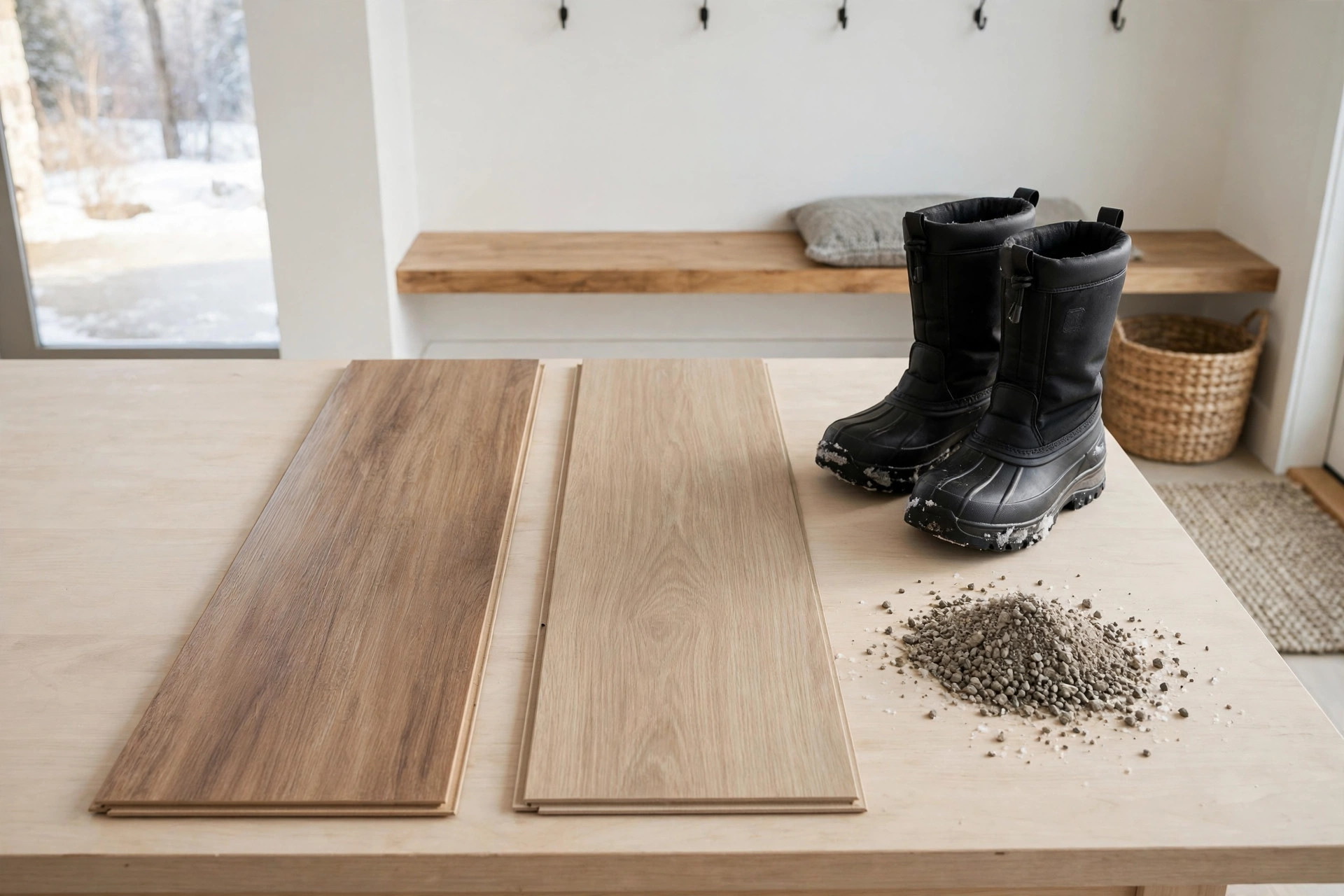
Luxury vinyl plank (LVP) and laminate are the two floors Canadian homeowners compare most often, and most comparison guides answer the question the same way: vinyl is waterproof, laminate feels more like wood, pick by room. That is true but incomplete. The two products are graded on completely different durability scales, their installed costs overlap more than the shelf prices suggest, and in a Canadian home the room that decides the question is usually the basement or the entryway, not the living room. This guide decodes the specs, runs the money math on dated Canadian prices, and ends with a decision framework that works room by room.
The short answer: room first, product second
Canadian flooring retailers and installers converge on the same split: vinyl plank is the safer choice for moisture-prone areas, basements, kitchens, bathrooms, laundry rooms, and rental properties, while laminate can be the better choice in dry living rooms, bedrooms, and offices where a firmer, more wood-like surface and strong scratch resistance matter more than water tolerance. Neither material is universally superior. The right answer depends on the room, the subfloor, the moisture conditions, the product quality, and the installation, which is why the rest of this guide is organized around those five factors instead of a single winner.
What each floor is actually made of
LVP is a layered plastic product: a printed wood- or stone-look design layer sits on a rigid waterproof polymer core, capped by a clear wear layer. The core comes in two main forms. SPC (stone plastic composite) is the dense, rigid version that dominates Canadian retail shelves. WPC (wood plastic composite) uses a foamed core that is softer and warmer underfoot, and is positioned for climate-controlled, above-grade rooms. Because the core does not absorb water, a spill that sits on LVP is a cleaning job, not a repair job.
Laminate is a wood-based product: a high-density fibreboard (HDF) core, a printed design layer, and a melamine wear layer hardened with aluminum oxide. Standard laminate relies on tight click joints and a treated core for water resistance, and prolonged exposure can swell the edges of the core. The newer water-resistant laminates narrow the gap with wax-sealed edges and moisture-resistant cores rated to handle spills for a limited window, an Ontario retailer describes that window as 24 to 200+ hours without joint swelling, but the same retailer is explicit that the product is not designed for standing water or fully wet environments. The dense HDF core does give laminate one real advantage: it resists denting and compression from heavy furniture better than softer vinyl cores, which can show indentations.
Decoding the specs: mils for vinyl, AC ratings for laminate
The most common shopping mistake is comparing the two durability numbers as if they were the same scale. They are not.
For LVP, durability is set by wear layer thickness, measured in mils (thousandths of an inch). Common products run 6 to 20 mil, and a 20 mil wear layer is considered excellent for busy homes. Total plank thickness, the 5 mm, 6.5 mm, 8 mm figures on the box, is mostly about rigidity and feel, not surface life. A concrete example from a Canadian retail shelf, checked 18 October 2026: the Home Decorators Collection Logan Oak at Home Depot Canada is a 5 mm plank, 7 in. × 48 in. with a 12 mil wear layer, click-lock installation, listed as 100% waterproof, sold in cases covering 23.77 sq. ft. with no acclimation required. Read in spec order, wear layer first, thickness second, that is a mid-duty residential floor regardless of how thick the box makes it sound.
For laminate, durability is set by the AC (Abrasion Class) rating, from European laminate testing in which an abrasive wheel runs against the surface until the wear layer is breached. AC3 is general residential and light commercial grade, the practical minimum for an actively used room. AC4 is heavy residential and general commercial grade, suited to hallways, kitchens, and small offices; an Ontario laminate retailer recommends AC4 for most residential applications, including kitchens, main floors, and mudrooms. AC5 is heavy commercial. One spec-verification rule applies to both products: a laminate that advertises wear-layer thickness but publishes no AC rating is a red flag, because reputable manufacturers publish the rating.
The numbers: dated Canadian prices and a cost-per-year test
Price ranges below were checked on 18 October 2026 against Canadian retailer and installer listings in Ontario and the GTA. They are material and installation ranges, not quotes, every project still needs a measured, itemized estimate.
| Cost / spec (checked 2026-10-18) | Luxury vinyl plank | Laminate |
|---|---|---|
| Material, Ontario retailer range | $2.50 to $7.00 / sq. ft. | $3.00 to $6.00 / sq. ft. (water-resistant lines) |
| Material, GTA installer range | $2.00 to $10.00 / sq. ft. | $1.00 to $8.00 / sq. ft. (all grades) |
| Professional installation, Ontario | $2.00 to $4.00 / sq. ft. | $2.00 to $3.50 / sq. ft. |
| Durability spec to compare | Wear layer, 6 to 20 mil | AC rating, AC3 minimum / AC4 preferred |
| Typical service life | 15 to 25 years | 10 to 20 years |
| Water behaviour | Waterproof core | Water-resistant; prolonged exposure swells edges |
| Weak point | Dents under heavy furniture; cannot be refinished | Moisture at joints and edges |
Per-square-foot ranges hide the real question, which is cost per year of service. Worked example, using the midpoints of the Ontario ranges above for a 500 sq. ft. main-floor project:
| 500 sq. ft. worked example | LVP | Water-resistant laminate |
|---|---|---|
| Material at range midpoint | $4.75 / sq. ft. = $2,375 | $4.50 / sq. ft. = $2,250 |
| Installation at range midpoint | $3.00 / sq. ft. = $1,500 | $2.75 / sq. ft. = $1,375 |
| Installed total | $3,875 | $3,625 |
| Assumed service life (range midpoint) | 20 years | 15 years |
| Cost per year of service | ≈ $194 / year | ≈ $242 / year |
The laminate is cheaper on the day it is installed and more expensive per year it serves, on these midpoint assumptions. Change the assumptions and the answer can flip, a dry upper floor where laminate reaches the top of its lifespan range closes most of the gap, but any comparison that stops at the shelf price is answering the wrong question. Two costs sit outside the tables: underlayment or transitions where the chosen product does not include them, and subfloor preparation, which both materials charge for when the existing floor is not flat and sound. Click-lock LVP can be floated over most existing hard surfaces if they are flat and structurally sound, which can remove a tear-out cost laminate sometimes cannot avoid.
Room by room in a Canadian home
Basements. LVP, with a condition covered in the next section: test the slab first. Laminate over concrete is the riskiest combination in this comparison, because the core's weak point, moisture at the edges, meets the wettest floor in the house.
Entryways and mudrooms. Canadian winters track in grit, salt, and meltwater daily. A waterproof core and a thick wear layer handle both the water and the abrasion; if laminate is used here, AC4 and a water-resistant line are the floor, not the upgrade.
Kitchens. Either can work. LVP forgives the dishwasher leak that laminate only tolerates for a limited window; laminate in AC4 handles chair and traffic wear well. The tie-breaker is how fast spills get found in that household.
Bedrooms and living rooms. Laminate's home turf: dry, lower moisture risk, and its firmer, more wood-like feel and dent resistance show at their best. WPC-core LVP is the vinyl answer where a warmer, quieter underfoot feel is the priority.
Bathrooms and laundry rooms. LVP. Standing water is a when, not an if, in these rooms, and water-resistant laminate is explicitly not designed for it.
Before either floor goes over concrete: the slab moisture test
A waterproof core protects the plank. It does not protect the installation: moisture vapour rising through a basement slab can build up under any floating floor, feed mould at the edges of the room, and void manufacturer conditions that assume a dry substrate. Before installing either material over concrete, run the plastic sheet test (ASTM D4263):
- Clean a patch of bare concrete and let the surface dry.
- Tape a clear plastic sheet, about 18 × 18 in., flat to the slab and seal all four edges with duct tape.
- Leave it undisturbed for 24 hours.
- Check the underside of the plastic and the concrete beneath it.
What success looks like: the plastic comes up dry and the concrete under it is the same colour as the surrounding slab, the floor is ready for the next step. Condensation on the plastic or a darkened patch of concrete means moisture is moving through the slab; that is a stop sign, not a shopping cue. The test is a pass/fail screen, not a measurement, so a wet result calls for finding and fixing the moisture source before any flooring budget is spent. The full diagnostic sequence is covered in the basement moisture guide on this site.
Decision framework: five questions
- Can this room get wet and stay wet? Yes → LVP. No → both stay in play.
- Is the floor below grade or over concrete? Yes → run the slab test first; a wet result pauses the project for either material.
- Which spec is on the box? Vinyl: wear layer in mils, 20 mil for busy homes. Laminate: AC rating, AC3 minimum, AC4 for kitchens, halls, and mudrooms. A missing rating is a reason to walk away.
- What does a year of service cost? Divide the installed total by the realistic lifespan for that room, not the shelf price by nothing.
- What fails first in this household? Dropped cast-iron pans and furniture dents argue for laminate's dense core; dogs, kids, and slow-found puddles argue for vinyl's waterproof one.
FAQ
Is luxury vinyl plank really waterproof? The plank and its core are waterproof, and spills sit on the surface without damaging it. The installation is not a waterproofing system: water or vapour coming up from below the floor is a subfloor problem that the slab test exists to catch.
Can laminate go in a basement? It is the highest-risk use in this comparison. Water-resistant lines, a verified-dry slab, and a proper moisture barrier are minimum conditions, and in a basement with any history of water entry, vinyl is the safer specification.
Which floor can be repaired? Both are repaired by replacing individual planks, which is why buying one extra case at installation time matters. Neither can be refinished the way real wood can; when the wear layer or AC surface is worn through, the plank is done.